
The ECU software number is the workshop’s address label for a calibration. Without it, a tuning discussion can drift into guesses about engine family, model year or badge name. With it, the original file becomes traceable and the technician has a much better chance of choosing the correct workflow.
Modern vehicles often share engine names across different emissions packages, gearbox strategies and ECU generations. Two cars can look identical to a customer and still need different handling when the original file is read, processed, archived and flashed.
Identity before modification
A software number helps identify the exact calibration family, revision and sometimes the market-specific emissions logic. It is not the only identity field, but it is one of the most useful. Hardware number, ECU type, protocol, read method and VIN should also be saved. Together, those details prevent a workshop from treating a file as generic when it is not.
What the number tells the job file
The job file should record what was read before anything was changed. This includes the original filename, ECU family, software number, checksum status, tool used, battery support and diagnostic state. If the vehicle returns later, the workshop can understand which file was delivered and why. Without that information, support becomes memory-based and fragile.
Why badge names are not enough
Badge names create risk. A 2.0 TDI, 320i or A200 label may cover multiple ECUs and software branches. Gearbox type and emissions standard can change the safe torque path. Even within one model, a software update from a dealer can change the calibration identity. The file should therefore be treated as evidence, not as an accessory to the model name.
Using the number inside an XRemover workflow
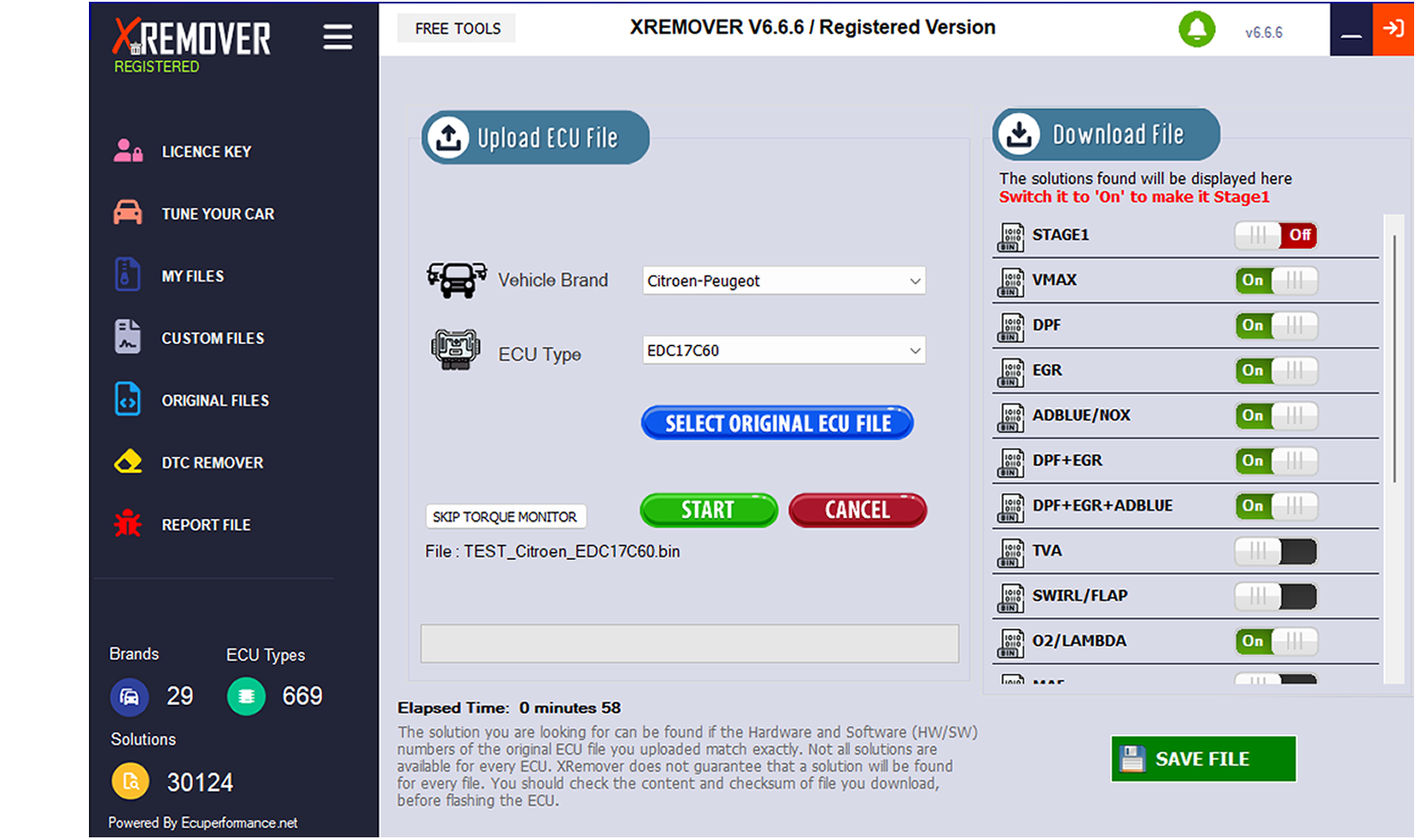
In XRemover, the technician selects the relevant brand and ECU context, uploads the original file and reviews supported solutions. The software identity remains important because it helps the workshop document what was uploaded and what came back. The platform can assist the file workflow, while the technician maintains the traceability around the job.
Support conversations become easier
When support is needed, a software number saves time. Instead of saying that a car has a problem after tuning, the workshop can provide the original file, tuned file, ECU identification and diagnostic notes. That changes the conversation from vague troubleshooting to a controlled review of a known calibration.
A clean archive habit
The best habit is simple: never overwrite the original read, never rename files so aggressively that identity is lost, and never deliver a tuned file without keeping the software number in the record. File discipline does not look dramatic, but it often prevents the most expensive support mistakes.
How ECU software number Fits Vehicle-Specific Stage Work
This concept should never be treated as a loose keyword that means the same thing on every vehicle. A BMW petrol saloon, a Volkswagen diesel SUV and a commercial van may all involve ECU software number, yet each job needs its own calibration decision. The useful approach is to keep the vehicle article close to the car, engine and ECU, while this reference page explains the technical idea in a stable and practical way.
A technician reading this page should be able to return to a customer job with clearer questions. Is the original file identified properly? Does the diagnostic state agree with the requested solution? Are the logs showing a real mechanical limit or a calibration choice? Has the customer use case been written down? Those questions keep ECU software number grounded in workshop practice rather than turning it into a generic phrase.
For handover, keep the language plain. Write down what was checked, what was changed, what was left stock, and what the customer should report if the vehicle behaves differently later. That short note turns ECU software number from an abstract tuning phrase into a service detail the workshop can support.
The best use of ECU software number is practical rather than decorative. It should help the technician decide whether to continue, revise, diagnose or reduce the target before delivery. When ECU software number appears in a vehicle-specific Stage 1 article, the reader should feel that it explains a real calibration choice, not that it was placed there for search engines only.
Workshop note: Ask for the ECU software number early, especially when a customer supplies a file remotely. If the identity is unclear, pause the job and solve that before calibration work begins.
This support article explains the "ECU software number" concept for professional ECU-file discussions. It is written as background reading for XRemover users and intentionally contains no rendered links.